
Release Information
- Model: 410 Program Recorder
- Released: 1979
- Manufacturer: Atari
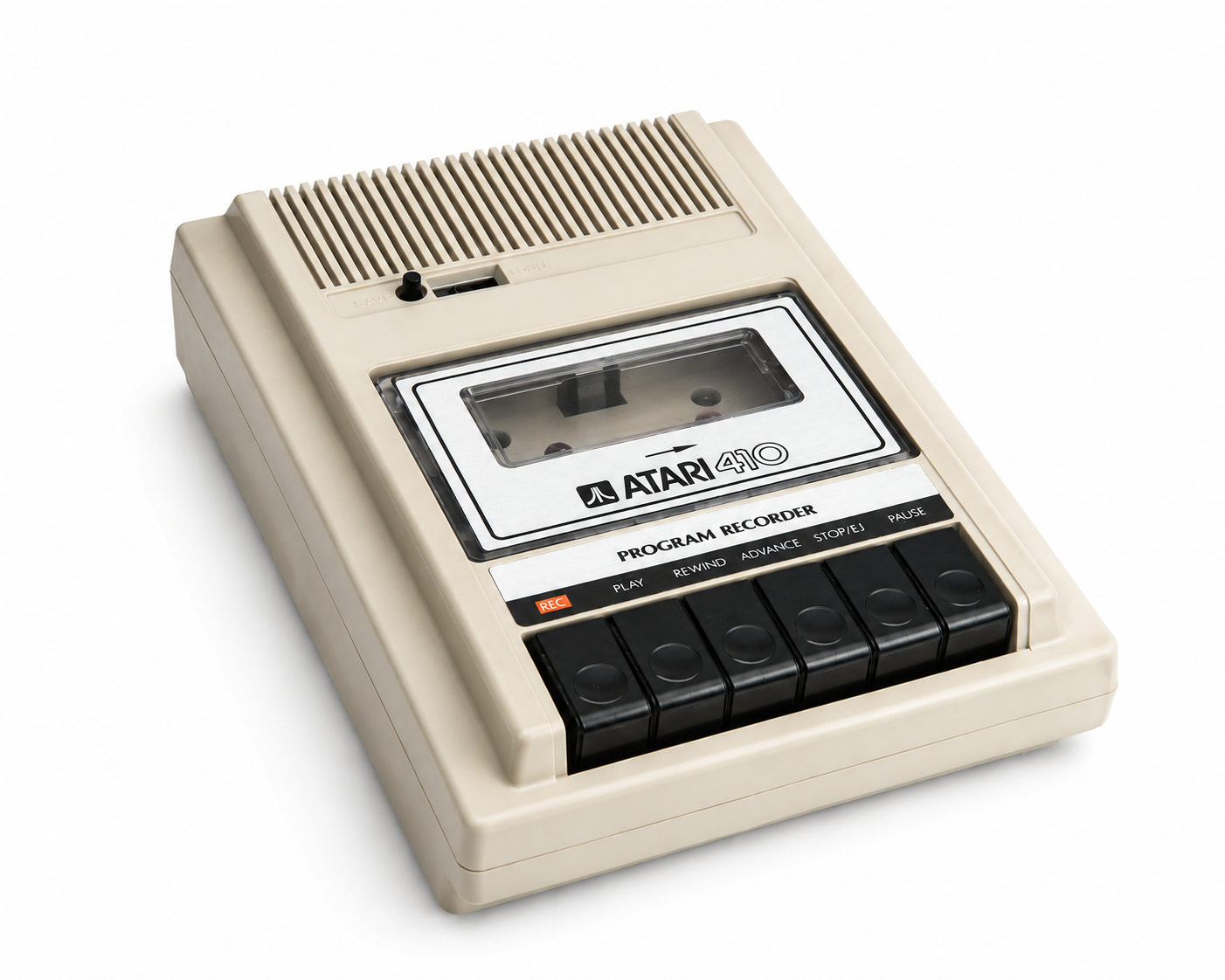
Atari 410 Program Recorder: The Sound of Loading an Atari
Before floppy disks became commonplace, Atari owners stored their programs on ordinary cassette tapes. The Atari 410 Program Recorder made it possible, one slow and sometimes frustrating byte at a time.
When Computers Used Cassette Tapes
Imagine sitting in front of your Atari 800 in 1980. You’ve just brought home a new game recorded on cassette tape. You insert the cassette into your Atari 410 Program Recorder, rewind it to the beginning, and prepare the computer to load the program.
You press PLAY, hear the mechanical click of the cassette mechanism, and wait.
And wait.
Depending on the program, you might find yourself sitting there for several minutes, hoping that everything is working properly. Unlike modern computers, there is no progress bar showing exactly how much longer the process will take. You’re trusting that the tape is good, the recording head is properly aligned, and the program will eventually appear on your television screen. If something goes wrong, you might have to rewind the cassette and start all over again.
Welcome to computing in the early 1980s.
For many early Atari owners, this was simply how computers worked. Cassette storage was affordable, widely available, and, despite its limitations, an important part of the early home computer experience.
Atari’s answer to the home computer storage problem was the Atari 410 Program Recorder, a peripheral that helped make the Atari 400 and 800 practical machines for programming, education, and entertainment.
The Arrival of the Atari 410
The Atari 410 Program Recorder was introduced in 1979 alongside Atari’s first home computers, the Atari 400 and Atari 800.
At the time, personal computers were still expensive machines, and purchasing a computer was only part of the investment. Owners also needed some method of loading software and saving their own programs.
Atari offered its 810 floppy disk drive as a more capable storage solution, but disk drives were expensive. For buyers trying to keep the cost of their new computer system under control, a cassette recorder was a much more affordable option.
The 410 offered a relatively inexpensive way to store computer programs on standard compact audio cassettes. In late 1979, the recorder appeared in the Sears catalogue at approximately $85 US.
It was an attractive option for families purchasing their first computer. Blank cassette tapes were inexpensive, could be purchased almost anywhere, and could be reused to store different programs.
More importantly, the 410 allowed owners to do something that was central to the early home computer experience: create their own software and save it for later.
Instead of typing the same BASIC program every time the computer was turned on, users could save their work to cassette and reload it when needed.
For an aspiring young programmer, that was a significant improvement.
What Made the Atari 410 Different?
At first glance, the Atari 410 looked much like a conventional portable cassette recorder. It featured familiar mechanical controls, including PLAY, RECORD, REWIND, and fast-forward functions.
However, the 410 was designed specifically to communicate with Atari’s home computers. Rather than relying on the microphone and earphone connections commonly used by other home computer cassette systems, Atari connected its recorder through the company’s Serial Input/Output (SIO) interface.
The SIO system was one of the more interesting features of Atari’s 8-bit computer architecture. It provided a standardized connection for peripherals such as disk drives, printers, modems, and cassette recorders.
The Atari 410 used a permanently attached SIO cable that plugged directly into the computer or into another compatible peripheral.
One limitation was that the recorder did not include a second SIO connector for attaching additional devices. Consequently, the 410 had to be placed at the end of an SIO peripheral chain. Later Atari cassette recorders, including the 1010, would improve on this arrangement.
The 410 also incorporated computer-controlled motor operation. Although the user still had to operate the cassette transport controls, the Atari computer could control when the recorder’s motor ran during data transfers. This was a useful feature because it allowed the computer to pause tape movement while processing instructions or preparing to load another block of data.
How the Atari 410 Stored Computer Programs
The Atari 410 did not store programs as digital files in the way we think of them today. Instead, it converted computer data into audio signals that could be recorded on magnetic tape.
This process used a technique called frequency-shift keying, or FSK.
Essentially, the computer represented binary information using two different audio frequencies. The Atari cassette system used approximately 3,995 Hz and 5,327 Hz to represent the two signal states. During recording, the computer generated these tones and sent them to the recorder, which stored them magnetically on the cassette tape. When loading a program, the process was reversed. The recorder played the recorded signals, and its electronics interpreted the frequencies so the computer could reconstruct the original data.
The standard Atari cassette data rate was 600 bits per second.
That may sound extraordinarily slow today, and it certainly was by modern standards. At 600 bits per second, a program containing 16 KB of data would require several minutes to load, even before accounting for tape formatting, synchronization, and other overhead. Larger programs could take considerably longer. And because cassette tape was a sequential storage medium, users couldn’t instantly jump to a particular program as they could with a disk drive.
They had to physically advance or rewind the tape until the correct recording was reached.
This was where the recorder’s mechanical tape counter became important.Owners often maintained handwritten lists of programs and their corresponding tape counter positions.
For example, a cassette label might contain entries such as:
- Counter 000 — BASIC Programs
- Counter 085 — Space Game
- Counter 175 — Graphics Demonstration
- Counter 250 — Utility Programs
These counter values were only approximate indicators of tape position and could vary between machines. Losing track of where a program began could mean spending several minutes searching through the cassette.
A Clever Feature: Data and Audio Together
One of the Atari 410’s most interesting features was its ability to support both computer data and conventional audio on separate tracks of the cassette.
Standard compact cassettes contain four tracks arranged as two stereo channels for each side.
Atari took advantage of this arrangement by recording computer data on one channel while leaving the other available for audio.
This meant a specially prepared cassette could contain both software and spoken instructions, narration, or music.
Educational software was a particularly good application for this feature. Atari’s Educational System made use of coordinated cassette audio and computer displays, allowing lessons to include spoken explanations while the computer presented information or interactive exercises on the screen. For the late 1970s and early 1980s, this was an imaginative way of combining media.
It also demonstrated that Atari was thinking beyond simple program storage. The company recognized that its home computers could become educational and multimedia devices. Although cassette-based audio instruction would eventually be replaced by more sophisticated technologies, the underlying concept was remarkably forward-looking.
Living With Cassette Storage
Anyone who used cassette storage on an early home computer will remember that it required patience. Saving a program was relatively straightforward. In Atari BASIC, a user could enter the command:
CSAVE
The computer would prepare to write the program to cassette. The user would press RECORD and PLAY together, then follow the computer’s prompts to begin recording.
Loading the program was accomplished with:
CLOAD
Again, the user would position the tape and press PLAY before initiating the operation. If everything worked correctly, the program would eventually appear in memory.
Unfortunately, things didn’t always work correctly.
Cassette storage was sensitive to a variety of conditions, including tape quality, magnetic head alignment, dirty recording heads, mechanical wear, and variations between recorders. A program successfully saved on one cassette recorder might prove difficult to load on another.
Even the physical condition of the cassette could make a difference.
Users learned to keep their equipment clean, use good-quality tapes, and avoid placing cassettes near magnetic fields. Perhaps the most frustrating experience was waiting several minutes for a program to load, only to receive an error near the end. Atari users occasionally encountered errors such as 138, indicating a device timeout, or 143, associated with a checksum problem.
The original Atari documentation even discussed the importance of positioning the tape beyond its transparent leader before recording. Starting too close to the beginning could prevent the computer from detecting the data correctly.
These were not unusual problems for cassette-based computer systems. Commodore, Sinclair, and other home computer owners faced similar challenges.
Yet, despite the occasional frustration, cassette storage remained an important and affordable method of distributing software during the early home computer era.
Different Versions of the Atari 410
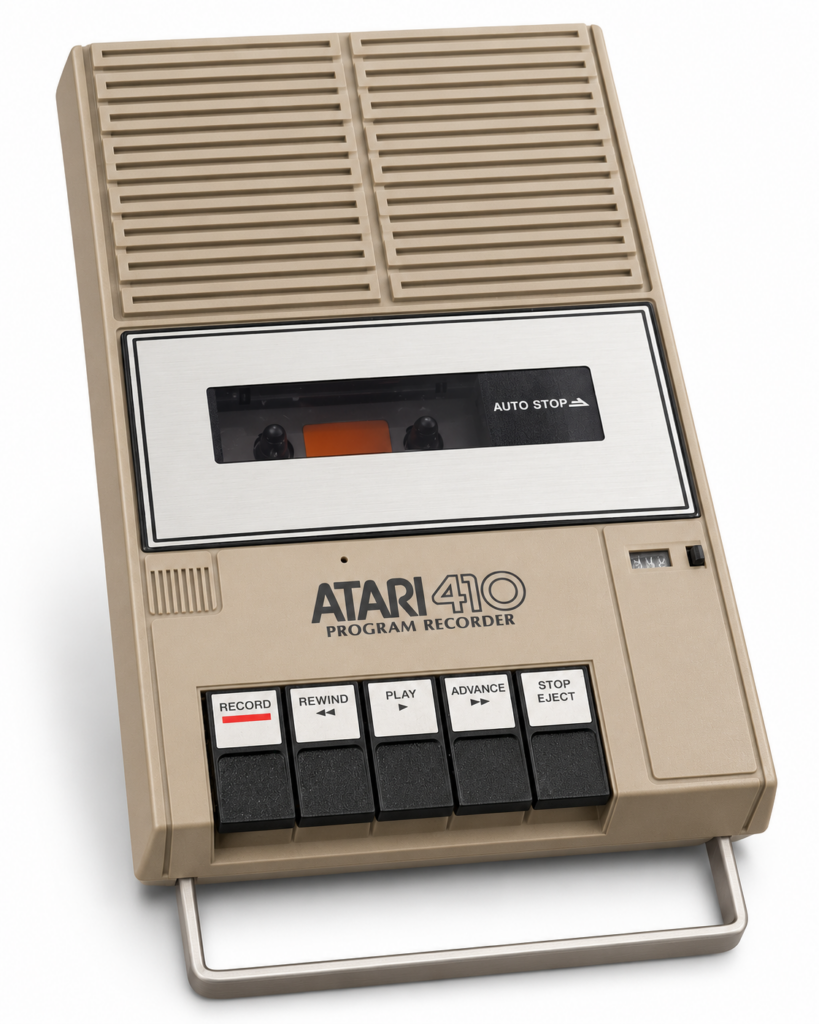
Collectors may be surprised to learn that Atari manufactured several versions of the 410 Program Recorder. The earliest production units were manufactured in Japan by Bigston. These recorders featured a distinctive carrying handle and a compact cassette-recorder design that was characteristic of the late 1970s.
Later units were manufactured in Hong Kong by companies including Transtek and Chelco. These revised models featured a different case design and control layout. The carrying handle disappeared, and the recorder adopted a somewhat more conventional appearance.
The later version generally included six operating keys: RECORD, PLAY, REWIND, ADVANCE, STOP/EJECT, and PAUSE.
Earlier models had different arrangements, including combined STOP/EJECT controls. Power arrangements also varied depending on the model and market. Many North American units used built-in AC power supplies, while certain international versions used external low-voltage adapters.
For collectors, these differences are worth knowing because two Atari 410 recorders can look noticeably different while serving essentially the same purpose.
Both represent authentic versions of Atari’s original cassette storage system.
The Atari 410 and the Arrival of Floppy Disks
Although cassette storage was an economical solution, its limitations became increasingly obvious as home computer software became more sophisticated. The Atari 810 floppy disk drive offered several important advantages.
Floppy disks provided significantly faster loading times, supported more convenient file management, and allowed programs and data to be accessed without manually searching through a cassette.
Instead of rewinding a tape and waiting for several minutes, users could load programs from disk far more efficiently. However, disk drives were expensive, and many Atari owners continued using cassette storage well into the 1980s.
The 410 remained available into the early 1980s before being succeeded by the Atari 1010 Program Recorder, introduced during the Atari XL computer era. The 1010 featured a design that better matched Atari’s newer computer systems and included improvements to peripheral connectivity.
Later models, including the XC11 and XC12, continued Atari’s cassette storage tradition in various markets.
For owners of the original Atari 400 and 800 computers, however, the 410 remained an iconic piece of equipment. It was the peripheral that allowed many early users to begin programming without investing in a costly disk drive.
Collecting an Atari 410 Today
Today, the Atari 410 Program Recorder is an interesting addition to any Atari 8-bit computer collection. Although floppy disk drives, modern flash storage solutions, and SIO-based emulators provide much more convenient ways to load software, the 410 offers an authentic experience of early Atari computing.
Finding a recorder in good cosmetic condition is often easier than finding one in perfect operating condition. After more than four decades, common mechanical issues can include deteriorated drive belts, dirty tape heads, hardened pinch rollers, and unreliable switches.
Fortunately, many of these issues can be addressed with careful cleaning and maintenance. Collectors should also verify that the recorder’s SIO cable is intact and that the power requirements match their local electrical supply.
Because the recorder uses real magnetic tape, the condition of the cassettes themselves is equally important. Old tapes may have degraded, and programs recorded decades ago may no longer load reliably.
Nevertheless, restoring a 410 to operating condition can be a rewarding project. There is something uniquely satisfying about loading a program from cassette on an original Atari 800, exactly as someone might have done in 1980.
Storage Medium
- Standard compact audio cassette
Data Transfer Speed
- 600 bits per second
Recording Format
- Frequency-shift keying (FSK)
Data Frequencies
- ~3,995 Hz and 5,327 Hz
Approximate Capacity
- 100,000 bytes per 60-minute cassette
Tape Transport Speed
- 1 7/8 inches per second
Track Arrangement
- Four-track, two-channel stereo
Audio Support
- Separate channel for narration or music
Computer Interface
- Atari SIO
Motor Control
- Computer-controlled
Notable Features
One of Atari’s first storage peripherals
- Cassette-Based Storage: Used standard audio cassette tapes to save and load computer programs affordably.
- 600-Baud Data Transfer: Recorded and loaded programs at 600 bits per second using frequency-shift keying (FSK).
- Dual-Track Recording: Supported computer data on one audio channel and narration or music on another, making it ideal for educational software.
Notable Facts
- Please create a list of 4 notable features of the Atari 410 program recorder. Only one sentence for each point.
- Affordable Storage: It provided an inexpensive alternative to floppy disk drives by using ordinary audio cassette tapes to store computer programs.
- Innovative Audio Support: Its dual-track recording system allowed educational programs to combine computer data with spoken instructions or music.
