
Release Information
- Released: 1992
- Manufacturer: Atari
- Type: 16/32-bit multimedia home computer
Atari Falcon 030 Computer
The Atari Falcon 030 was the final and most advanced home computer released by Atari and remains one of the most ambitious systems the company ever created. Introduced in 1992, the Falcon represented Atari’s attempt to push beyond traditional home computing and move into advanced multimedia, digital audio, and creative production. Combining a Motorola 68030 processor, enhanced graphics capabilities, true digital audio support, and a powerful Digital Signal Processor (DSP), the Falcon was years ahead of many competing home computers in several important areas.
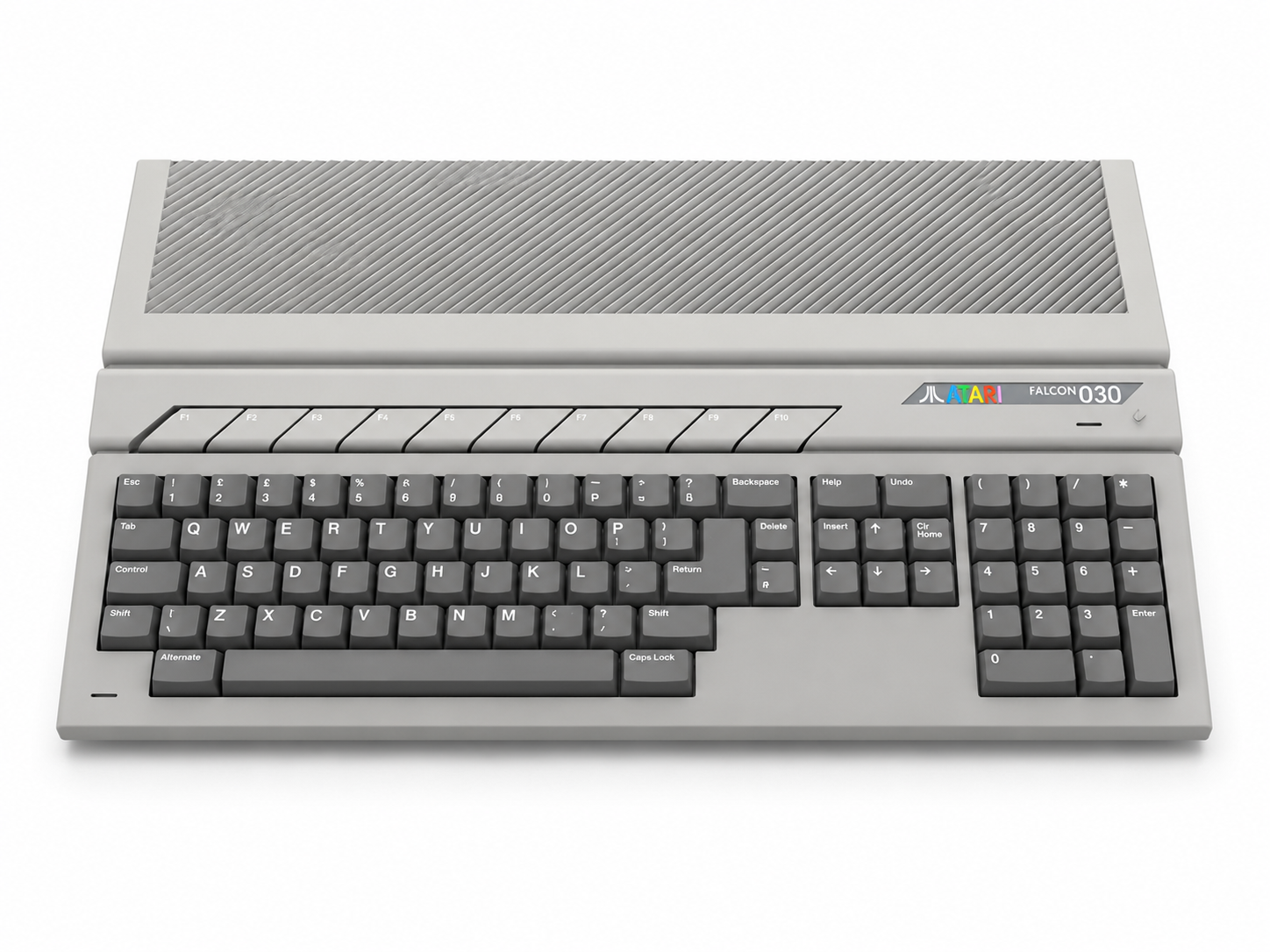
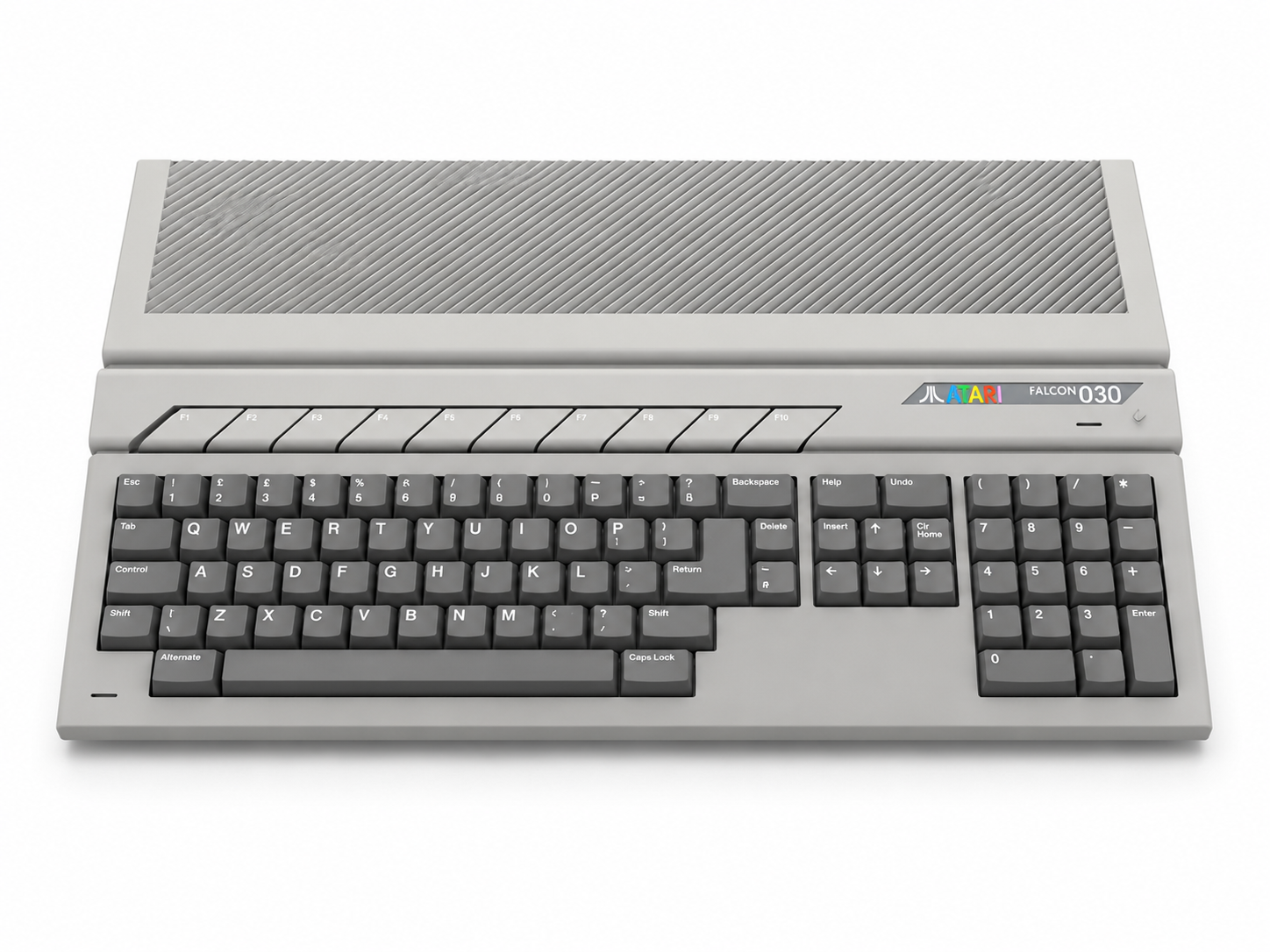
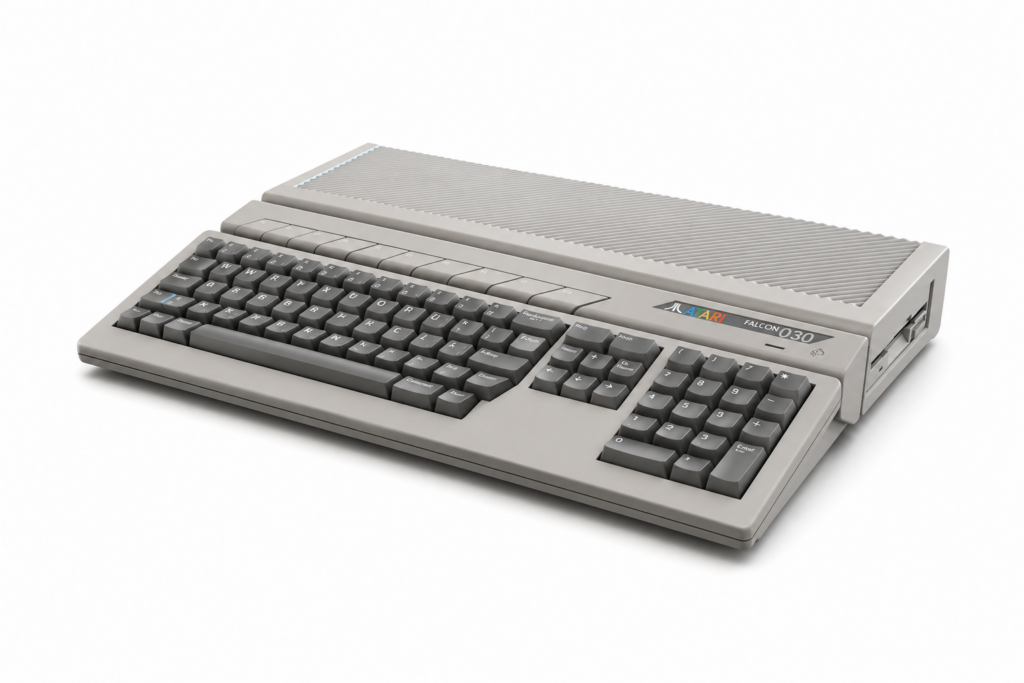
Visually, the Atari Falcon retained the familiar all-in-one keyboard computer design used by earlier Atari ST systems, but with a more refined and modern appearance. The compact gray case featured a built-in floppy disk drive, a full-travel keyboard, and numerous expansion ports that reflected the system’s multimedia ambitions. Although the Falcon maintained compatibility with much of Atari’s existing ST software library, it also introduced significant new hardware capabilities that allowed developers to create much more advanced applications.
At the heart of the Falcon was the Motorola 68030 processor running at 16 MHz, paired with the Motorola 56001 Digital Signal Processor. The DSP was one of the Falcon’s most important and revolutionary features, enabling real-time digital audio processing, effects generation, signal analysis, and advanced multimedia applications that were extremely uncommon in home computers of the early 1990s. This made the Falcon especially attractive to musicians, recording studios, audio engineers, and demo scene programmers.
The Falcon became highly respected for its digital audio capabilities. Unlike earlier Atari computers, the Falcon supported true 16-bit stereo audio recording and playback, making it a serious low-cost music production workstation. Combined with Atari’s built-in MIDI ports — a feature carried forward from the ST line — the Falcon became an extremely powerful platform for sequencing, audio editing, and electronic music production. Many musicians and studios continued using Atari systems for years because of their reliability and strong MIDI performance.
Graphically, the Falcon introduced improved color depth, enhanced video modes, and VGA monitor support. The system could display significantly more colors than earlier Atari ST computers and supported a variety of resolutions suitable for gaming, graphics work, desktop publishing, and multimedia applications. The Falcon also gained popularity in the demo scene, where programmers pushed the machine’s hardware far beyond its original intended capabilities through advanced graphics and sound programming techniques.
Despite its impressive technology, the Falcon faced major commercial challenges. By the early 1990s, the computer market had become highly competitive, with IBM-compatible PCs and Apple Macintosh systems rapidly advancing in performance and popularity. Atari also struggled with limited marketing, small production runs, and relatively weak third-party software support compared to larger competitors. As a result, the Falcon had a relatively short commercial lifespan before Atari shifted focus toward the Jaguar game console.
Even though it was not a commercial success, the Atari Falcon developed an extremely loyal following among musicians, programmers, retro computing enthusiasts, and demo scene artists. Many users considered it one of the most innovative and creatively inspiring computers Atari ever produced. Even today, new software, hardware upgrades, accelerators, networking devices, and storage solutions continue to be developed for the Falcon community.
The Atari Falcon remains an important milestone in computer history because it represented one of the earliest affordable multimedia computers aimed at creative users. Its combination of advanced audio processing, graphics capabilities, MIDI integration, and DSP technology helped establish it as one of the most unique and respected computers of the early 1990s.
CPU
- Motorola 68030
- Clock Speed: 16 MHz
DSP Processor
- Motorola 56001 DSP
- Clock Speed: 32 MHz
Graphics
- Enhanced Falcon graphics architecture
- VGA monitor support
- Multiple graphics resolutions
- Support for thousands of colors on screen
- True-color display modes
Sound
- 16-bit stereo audio
- Digital audio recording and playback
- Real-time DSP audio processing
- Built-in MIDI ports
Memory
- RAM: 1 MB, 4 MB, or 14 MB configurations (depending on model and upgrades)
Storage Support
- Internal 3.5-inch floppy disk drive
- Internal IDE hard drive support
- External storage peripheral support
Operating System
- Atari TOS operating system
- GEM graphical user interface
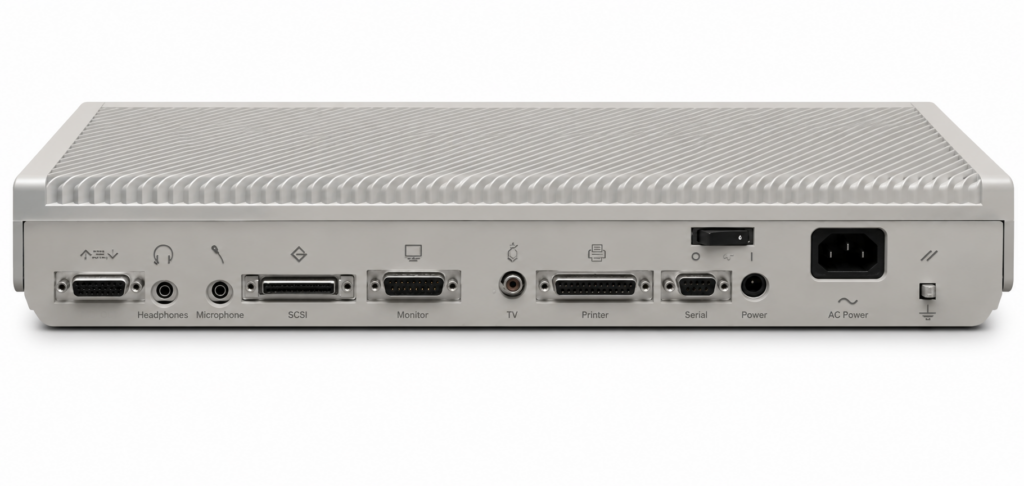
Ports & Expansion
- MIDI In/Out ports
- SCSI support
- IDE interface
- Joystick and mouse ports
- Serial and parallel ports
- VGA monitor output
Physical Design
- Compact all-in-one keyboard computer
- Built-in floppy drive
- Gray desktop case design
Notable Features
Built-in Digital Signal Processor (DSP)
- Advanced multimedia and audio capabilities
- Strong music production and MIDI support
- Popular in the demo scene community
- Atari’s final home computer platform
Notable Facts
- The Atari Falcon 030 was one of the first affordable home computers with a built-in DSP processor dedicated to multimedia tasks.
- Many professional musicians continued using Atari Falcon systems for MIDI sequencing well into the 2000s because of their timing accuracy.
- The Falcon’s DSP processor could be programmed independently, allowing developers to create highly advanced real-time audio and graphics effects.
