
Release Information
- Released: 1975
- Manufacturer: Atari
- Retail Branding: Sears Tele-Games
- Type: Dedicated home video game console
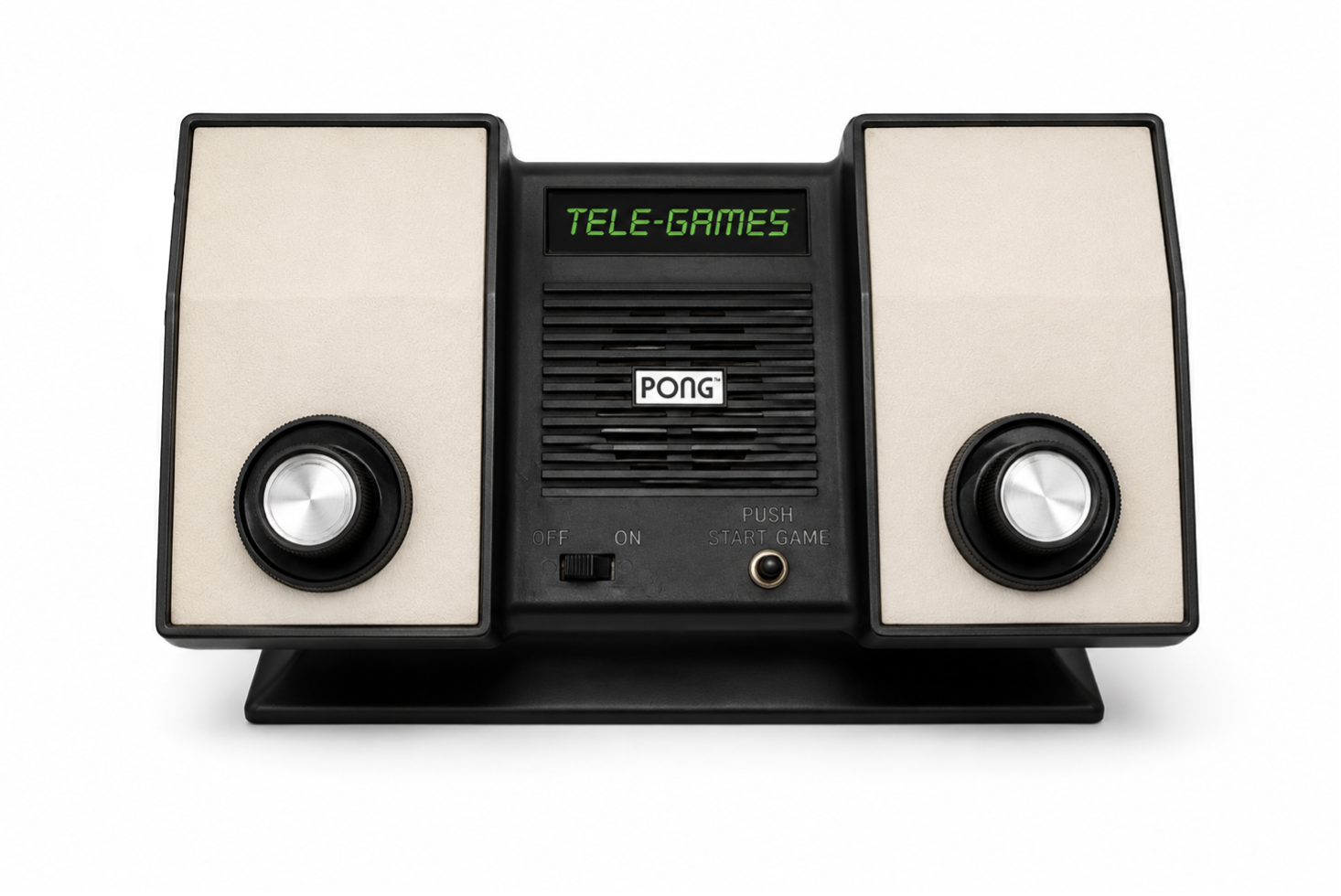
The Atari Home Pong
Often sold under the Sears Tele-Games name, was one of the most important early home video game systems ever released. Introduced in 1975 through a partnership between Atari and Sears, the console brought the excitement of arcade-style electronic gaming directly into the living room at a time when home video games were still a completely new idea for most families. While simple by modern standards, the Atari Tele-Games console helped establish the foundation of the home gaming industry and demonstrated that video games could become a mainstream form of home entertainment.
The system was based on Atari’s hugely successful arcade game Pong, which had become a cultural phenomenon in bars, arcades, and public spaces during the early 1970s. Atari realized that people wanted to experience electronic gaming at home, and the Sears partnership provided the perfect opportunity to reach a mass consumer audience. Sears marketed the console under its “Tele-Games” brand for the 1975 holiday season, and demand quickly exceeded expectations. The success of the system helped ignite the first major home video game boom.
Unlike later cartridge-based systems such as the Atari 2600, the Atari Tele-Games console contained built-in games and did not use interchangeable cartridges. Players connected the system directly to a television and used rotary paddle controllers to control on-screen paddles in simple electronic sports games. The experience was easy to understand, highly social, and immediately entertaining, making it ideal for family living rooms and casual gatherings.
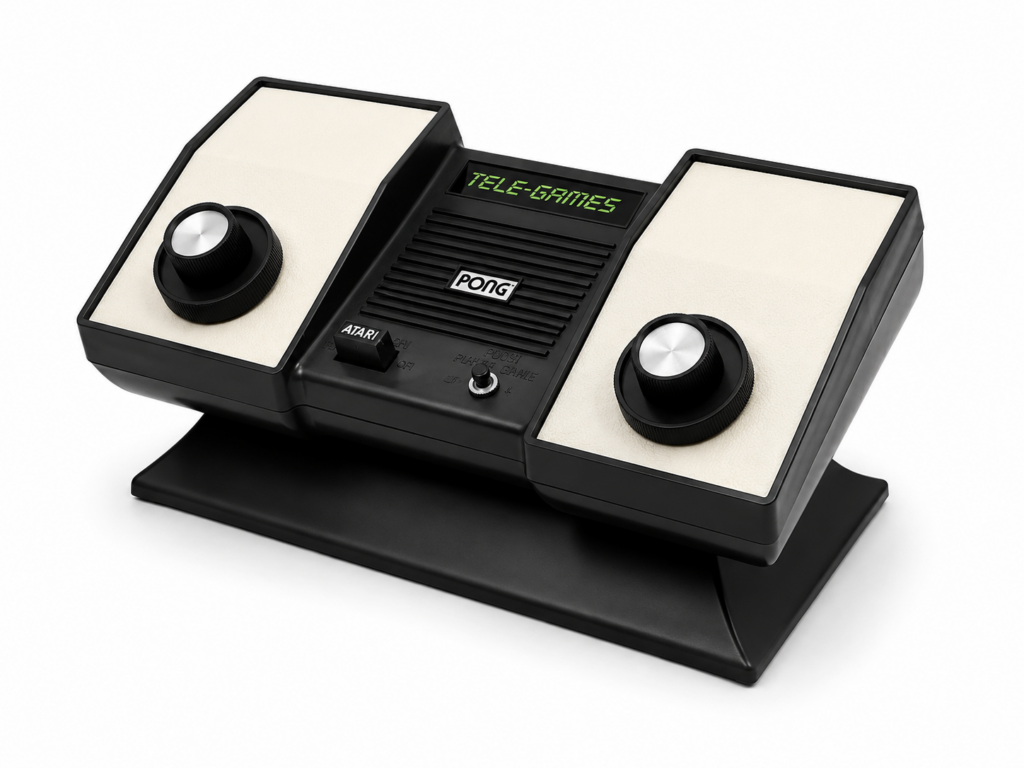
The console’s design reflected the style of 1970s consumer electronics, featuring a compact plastic housing with integrated paddle controllers and simple switches for selecting game variations. Despite its technical simplicity, the system represented a major technological leap for home entertainment. For many families, this was the first time a television became something interactive instead of simply a passive screen for watching programs.
Today, Atari Tele-Games and Home Pong systems are highly collectible pieces of gaming history. They represent the earliest days of the home video game industry and the moment when electronic gaming first entered everyday family life. While later Atari consoles would become far more advanced, the Tele-Games console remains one of the most historically significant systems ever produced because it helped prove that home gaming could become a global phenomenon.
Processor & Hardware
- Single-chip Pong-style game hardware
- Based on dedicated integrated gaming circuitry
- No programmable CPU in the modern sense
Games
Built-in electronic sports-style games including:
- Pong
- Hockey
- Practice/Solo modes
- Variations depending on model
Controllers
- Two built-in rotary paddle controllers
- Analog dial controls for paddle movement
Graphics & Sound
- Black-and-white style graphics
- Simple square ball and line graphics
- Basic electronic sound effects
Display Output
- RF television output
- Compatible with standard CRT televisions
Power
- External AC power adapter
- Some later models supported battery operation
Media Format
- No cartridges
- Games permanently built into the console
Physical Design
Experience the fusion of imagination and expertise with Études Architectural Solutions.
Historical Importance
One of the first successful home video game systems
- Helped launch the home gaming industry
- Brought arcade-style gaming into family living rooms
- Established Atari as a major name in electronic entertainment

Pong in Video Game History
- Pong was one of the first commercially successful video games in history.
- Pong helped introduce arcade gaming to a mainstream audience.
- The success of Pong helped launch the modern home video game industry.
